The biggest challenge most UK dental practices face isn't clinical skill — it's consistently attracting the right kind of new patients. Not just any patients, but patients who value quality care, follow through with treatment plans, and refer others.
This guide covers the most effective patient acquisition strategies for UK dental practices in 2026, from digital marketing essentials to reputation management and the emerging role of patient matching platforms.
Why "more patients" is the wrong goal
Before diving into tactics, a mindset shift: the goal isn't more patients — it's better-fit patients. A practice that sees 50 well-matched patients per week will outperform one that sees 80 mismatched ones. Better-fit patients:
- Accept treatment plans at higher rates
- Generate higher case values
- Cause fewer cancellations and no-shows
- Leave better reviews
- Refer friends and family
Every strategy below should be evaluated through this lens: does it attract patients who are a good fit for what my practice offers?
1. Optimise your Google Business Profile
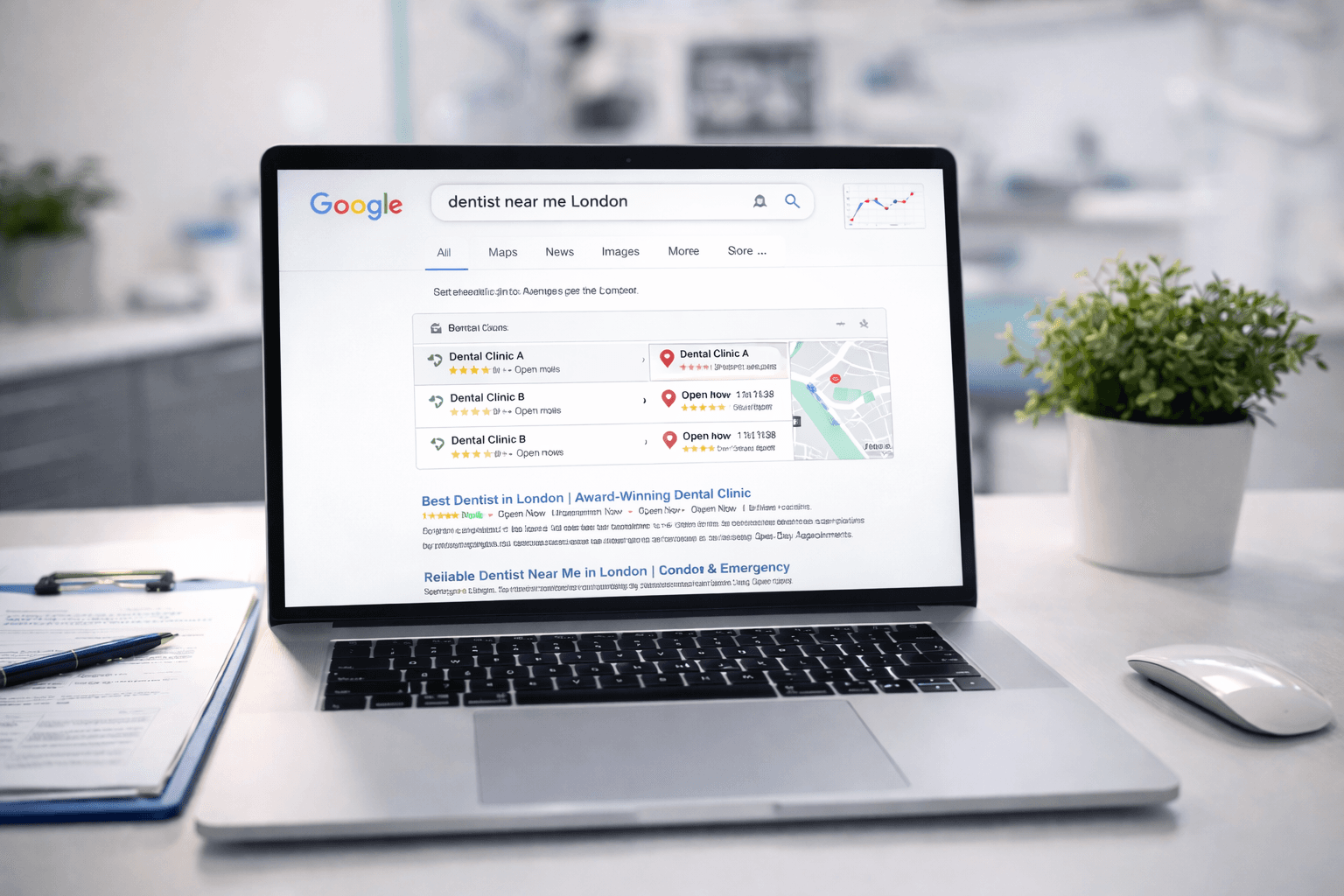
Your Google Business Profile (GBP) is the single most important digital asset for attracting local patients. When someone searches "dentist near me" or "dentist in [area]", GBP results appear above organic search results.
Essential optimisations
- Complete every field — name, address, phone, website, hours, services offered, insurance/payment options, accessibility features
- Choose the right primary category — "Dentist" is the default, but add secondary categories like "Cosmetic Dentist", "Orthodontist" or "Emergency Dental Service" if applicable
- Add high-quality photos — exterior (so patients can find you), reception area, treatment rooms, team photos. Practices with 100+ photos get significantly more engagement
- Post regularly — GBP posts appear in your profile and signal activity to Google. Share updates, offers, team news, treatment information
- Enable messaging — let potential patients contact you directly through Google
- Add your services with descriptions — list each treatment you offer with a brief description
Reviews are critical
Google reviews directly impact your local ranking and patient decision-making:
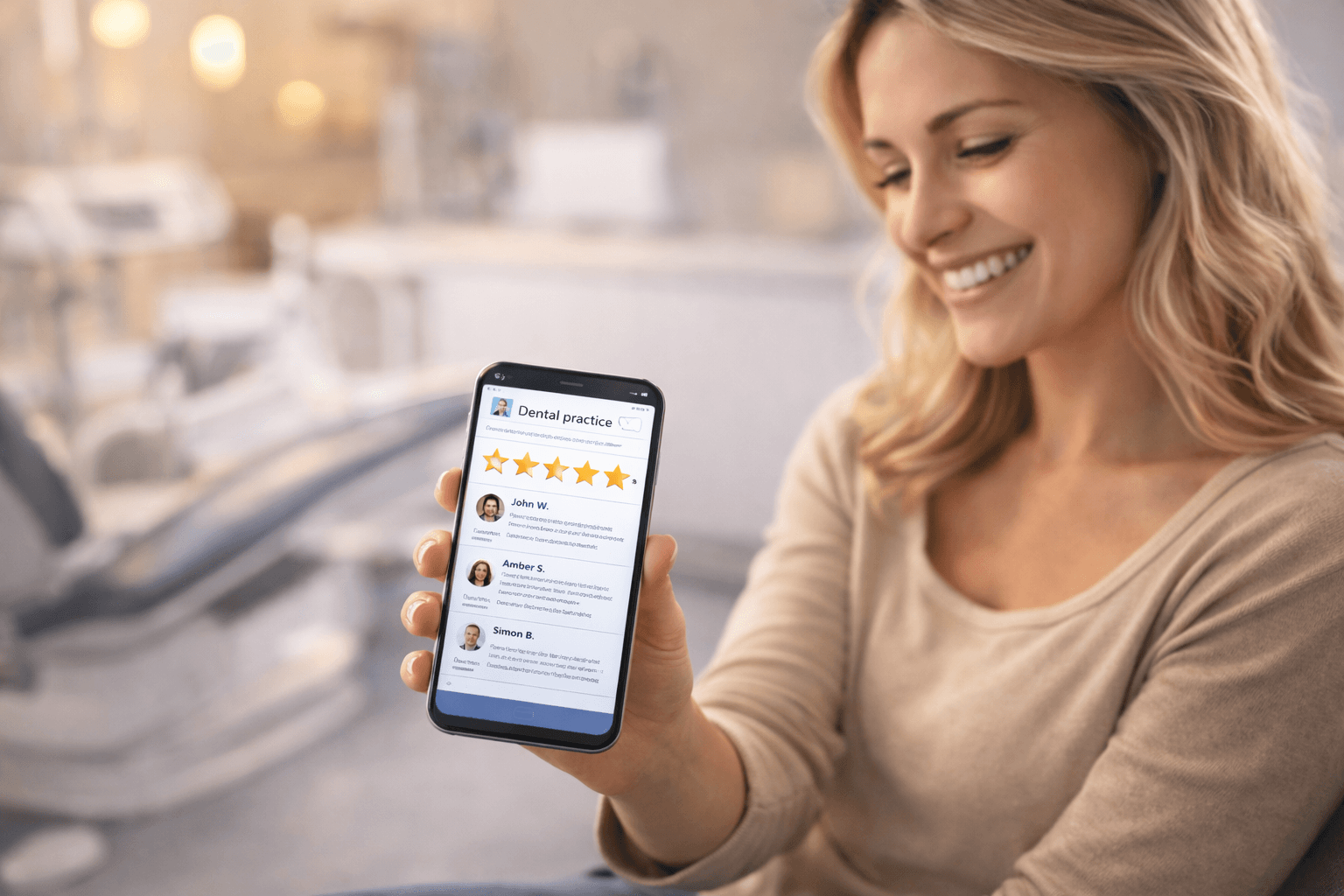
- Ask every satisfied patient for a review. The best time is immediately after a positive experience, while they're still in the practice
- Respond to every review — thank positive reviewers by name, and address negative reviews professionally and constructively
- Never buy or fake reviews — Google's algorithms detect this and the penalties are severe
- Aim for consistency — a steady stream of reviews is better than sporadic bursts
For detailed review strategies, read our guide on getting more online reviews for your dental practice.
2. Local SEO for dental practices
Local SEO ensures your practice appears in search results when patients in your area look for dental services.
Key local SEO actions
- Consistent NAP — your Name, Address and Phone number must be identical across your website, GBP, directories and social profiles. Even minor inconsistencies (e.g., "Street" vs "St") can hurt rankings
- Local directory listings — claim and update your profiles on NHS Choices, Yell, Yelp, Trustpilot, Free Index, and dental-specific directories
- Location-specific content — create pages on your website targeting "[treatment] in [area]" keywords (e.g., "Invisalign in Canary Wharf")
- Schema markup — add LocalBusiness and Dentist structured data to your website so search engines understand your location, services and reviews
For a complete walkthrough, see our dental practice SEO guide.
3. Build a website that converts
Most dental practice websites look the same: stock photos of smiling faces, a list of treatments and a "Contact Us" page. To stand out and convert visitors into patients:
Above the fold
The first screen a visitor sees should communicate:
- What you specialise in — don't try to be everything to everyone
- Where you're located — area name prominently displayed
- A clear call to action — "Book a consultation", "Call us", or "Check availability"
- Social proof — your Google rating, number of reviews, or "Trusted by 2,000+ patients"
Treatment pages
Each major treatment deserves its own page with:
- A clear explanation of the procedure
- Pricing (or at least starting-from prices)
- Before-and-after photos (with patient consent)
- FAQ section addressing common concerns
- A call to action to book or enquire
Pricing transparency
Practices that show their prices convert at higher rates. Patients searching for dental costs are already motivated — if they can't find your prices, they'll go to a competitor who shows theirs.
You don't need to list every fee. Start with:
- Check-up and hygienist prices
- Starting-from prices for popular treatments
- Finance options and monthly payment examples
Mobile experience
Over 60% of dental searches happen on mobile. Your site must load fast, display properly on all screen sizes, and make it easy to call or book from a phone.
4. Content marketing that builds trust
Creating helpful content positions your practice as a trusted authority and captures patients at the research stage of their journey.
Blog topics that attract patients
Write about what your patients actually search for:
- "How much does [treatment] cost in [area]?"
- "What to expect during [procedure]"
- "[Treatment A] vs [Treatment B]"
- "Is [treatment] right for me?"
Video content
Short videos (60–90 seconds) perform exceptionally well:
- Practice tours showing the environment
- Dentist introductions — patients want to "meet" you before booking
- Treatment explainers in plain language
- Patient testimonial videos (with consent)
Post videos on your website, YouTube, Instagram Reels and TikTok. Google increasingly shows video results for dental queries.
5. Patient referral programmes
Word-of-mouth remains the highest-converting acquisition channel. A structured referral programme amplifies it:
- Offer a tangible reward — a discount on their next treatment, a free hygienist appointment, or a gift card
- Make it easy — give patients a referral card or a unique link they can share digitally
- Thank both parties — reward the referrer and welcome the new patient with a small gesture
- Track referrals — know which patients are your best advocates
The best referral programmes are simple and generous. A £50 credit for each referred patient who books a check-up typically generates strong results.
6. Patient matching platforms
Traditional patient acquisition puts the burden on the clinic to market, advertise and convert. Patient matching platforms like Pearlie take a different approach: they connect patients who have already expressed their needs, budget and preferences with clinics that are a good fit.
How matching platforms differ from directories
| Feature | Directories (Yell, NHS Choices) | Matching platforms (Pearlie) |
|---|---|---|
| Patient intent | Browsing | Pre-qualified, expressed needs |
| Information shared | Clinic listing only | Patient priorities, budget, concerns |
| Fit assessment | None — patient picks from a list | Algorithm matches based on fit |
| Conversion rate | Low (patient contacted many) | Higher (patient is pre-matched) |
| Cost model | Fixed listing fee or PPC | Performance-based or partnership |
The advantage for clinics is that patients arrive with clarified expectations, making consultations more productive and treatment acceptance rates higher.
7. Paid advertising (use strategically)
Google Ads and social media advertising can generate immediate patient flow, but should be part of a broader strategy, not the sole approach.
Google Ads best practices for dentists
- Target high-intent keywords — "emergency dentist [area]", "Invisalign [area]", "dental implants near me"
- Use location targeting — restrict ads to your catchment area
- Send traffic to treatment-specific landing pages — not your homepage
- Track conversions — know your cost per new patient, not just cost per click
- Set a daily budget — start with £20–50/day and scale based on results
Social media advertising
Facebook and Instagram ads work well for:
- Promoting special offers (e.g., new patient check-up at £49)
- Showcasing before-and-after transformations
- Targeting specific demographics in your area
- Retargeting website visitors who didn't book
8. Email and re-engagement
Not every potential patient books on their first visit to your website. Build a system to stay in touch:
- Recall system — automated reminders for check-ups and hygienist appointments
- Treatment follow-up — for patients who received a treatment plan but haven't booked
- Monthly newsletter — practice news, dental tips, special offers
- Re-engagement campaigns — reach patients who haven't visited in 12+ months
A well-maintained patient database is one of your most valuable assets.
Measuring what works
Track these metrics to understand which channels deliver the best patients:
- New patient bookings per month — total and by source
- Cost per acquisition (CPA) — how much you spend to acquire each new patient
- Treatment acceptance rate — what percentage of patients accept recommended treatment
- Patient lifetime value (LTV) — average revenue per patient over their time with your practice
- Review generation rate — new reviews per month
The best acquisition channels deliver high LTV patients at a reasonable CPA — not just the most patients at the lowest cost.
Getting started
You don't need to implement everything at once. Start with the highest-impact, lowest-effort actions:
- Optimise your Google Business Profile — this costs nothing and has immediate impact
- Ask for reviews systematically — build social proof that compounds over time
- Add pricing to your website — remove a major barrier to enquiries
- Create 3–5 treatment pages with local keywords — capture search traffic
- Set up a referral programme — leverage your happiest patients
Then layer in content marketing, paid advertising and platform partnerships as your budget and capacity allow.
Pearlie helps dental clinics receive better-matched patient enquiries. Learn about joining Pearlie's clinic network.
Looking for a dentist?
Pearlie matches you with verified, GDC-registered clinics tailored to your needs. Free and independent.
Find my clinic