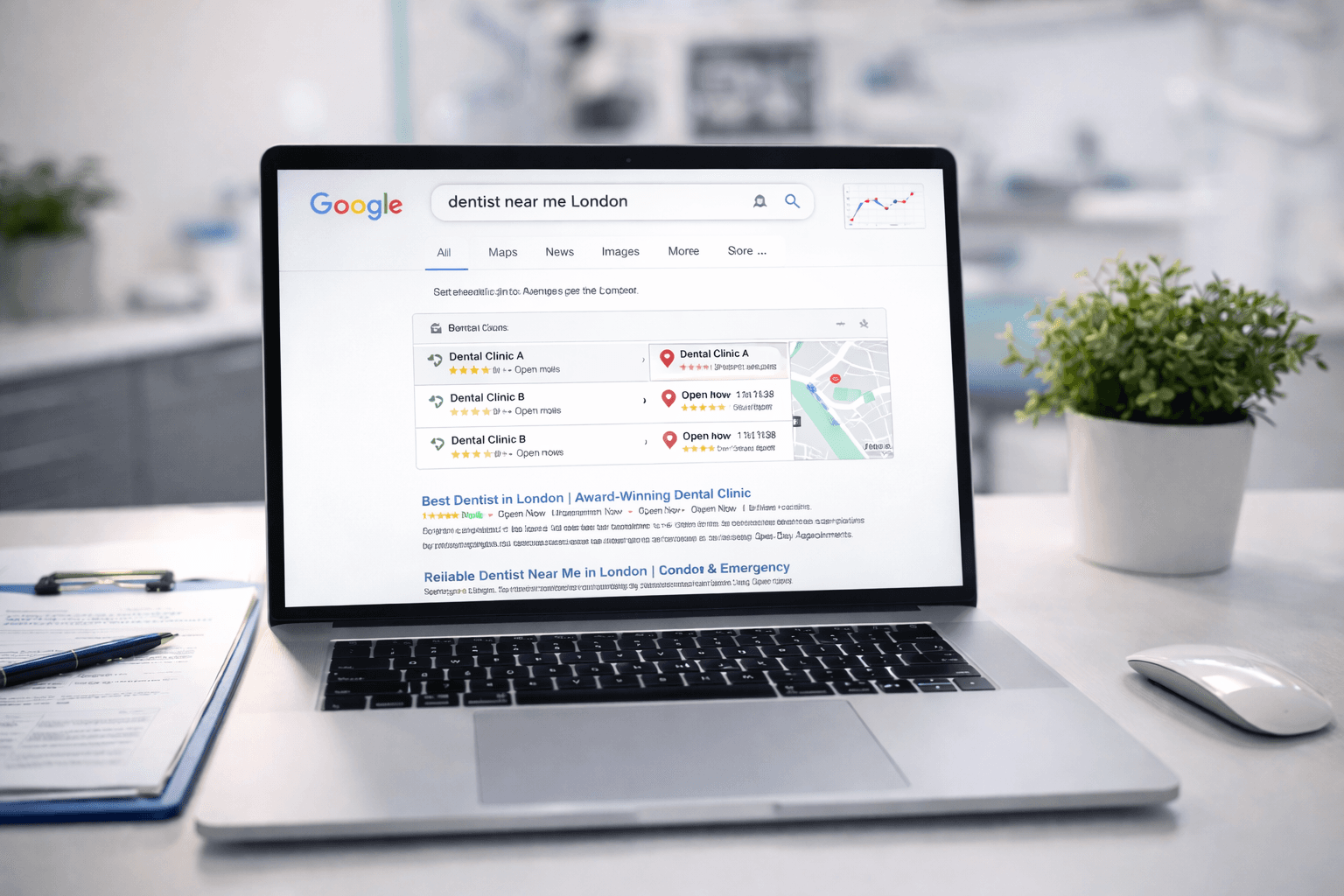
When a potential patient searches "dentist near me" or "Invisalign in [your area]", where does your practice appear? If you're not on the first page of Google — and ideally in the top three results — you're invisible to the majority of patients looking for a dentist.
Search engine optimisation (SEO) is the process of making your dental practice website and online presence more visible in search results. Unlike paid advertising, organic SEO delivers compounding returns: the work you do today continues to drive patient enquiries for months and years.
This guide covers the key SEO strategies specifically for UK dental practices, from local search optimisation to content creation and technical foundations.
Why SEO matters for dental practices
The numbers tell the story:
- 90% of patients use online search to find a new dentist
- 46% of all Google searches have local intent
- The top 3 results in Google's "Local Pack" receive the majority of clicks
- Organic search typically has a lower cost-per-acquisition than paid ads over time
Unlike paid advertising (which stops generating enquiries the moment you stop paying), SEO builds lasting visibility. A well-optimised page can generate enquiries for years.
Local SEO: the foundation
For dental practices, local SEO is everything. Patients search for dentists in their area, and Google prioritises local results.
Google Business Profile (GBP)
Your GBP listing is the single most important factor in local dental SEO. When someone searches "dentist near me", Google shows a map with three highlighted businesses (the "Local Pack"). Getting into this pack is your top priority.
Essential GBP actions:
- Claim and verify your listing at business.google.com
- Complete every section — business name, address, phone, website, hours, services, attributes
- Choose accurate categories — Primary: "Dentist". Add relevant secondaries: "Cosmetic Dentist", "Emergency Dental Service", "Orthodontist", "Dental Implants Provider"
- Write a compelling description — 750 characters highlighting your specialities, experience and location
- Add photos regularly — exterior, interior, team, equipment. Aim for 50+ photos and add new ones monthly
- Post weekly — share updates, offers, tips. GBP posts show directly in your listing
- Enable all features — messaging, booking link, Q&A responses
- Keep hours accurate — including bank holidays and special hours
NAP consistency
NAP stands for Name, Address, Phone number. These must be identical across every online listing:
- Your website
- Google Business Profile
- NHS Choices
- Yell, Yelp, Trustpilot, FreeIndex
- Social media profiles
- Dental directories (DentalFocus, WhatClinic, etc.)
Even small variations ("St" vs "Street", missing suite numbers, different phone formats) create inconsistencies that confuse search engines and can hurt your rankings.
Local citations
A citation is any online mention of your practice's NAP. The more consistent citations you have across reputable directories, the more confident Google is about your business information.
Priority directories for UK dental practices:
- NHS Choices / NHS Find a Dentist
- Google Business Profile
- Yell.com
- Trustpilot
- Yelp UK
- FreeIndex
- WhatClinic
- Dental Focus
- CQC (Care Quality Commission)
- Facebook Business Page
Reviews and ratings
Google reviews are a major local ranking factor. Practices with more (and higher-rated) reviews consistently rank better in local search.
Review strategy:
- Ask every patient after a positive experience
- Send a follow-up text or email with a direct link to your Google review page
- Respond to every review within 24–48 hours
- Address negative reviews professionally — your response is read by prospective patients
- Never offer incentives for reviews (this violates Google's policies)
For in-depth review strategies, see our article on managing online reviews.
On-page SEO for dental websites
On-page SEO is about making each page of your website clearly relevant to the searches you want to rank for.
Title tags and meta descriptions
Every page needs a unique, descriptive title tag and meta description:
- Title tag formula: [Treatment/Service] in [Area] | [Practice Name]
- Example: "Invisalign in Canary Wharf | Docklands Dental Studio"
- Meta description: 150–160 characters describing the page content with a call to action
- Example: "Expert Invisalign treatment in Canary Wharf. Free consultation, flexible payment plans. Book online or call 020 1234 5678."
Treatment pages
Create a dedicated page for each major treatment you offer. Each page should include:
- H1 heading with the treatment name and location: "Dental Implants in [Area]"
- 500–1,500 words of original, helpful content about the treatment
- Pricing information (or "starting from" prices)
- FAQs — 3–5 questions patients commonly ask about the treatment
- Before-and-after photos (with consent)
- A clear call to action — phone number, booking form or enquiry button
- Internal links to related treatments and your about page
Location pages
If you serve multiple areas, create pages targeting each one:
- "Dentist in [Neighbourhood]"
- "Emergency Dentist [Area]"
- "[Treatment] in [City]"
Each location page should include unique content about serving that area, not just a copy of your homepage with the location name swapped in.
Header structure (H1, H2, H3)
Use a logical heading hierarchy:
- H1 — one per page, the main topic
- H2 — major sections (treatment details, pricing, FAQ)
- H3 — subsections within H2s
Search engines use headers to understand your content structure. Well-organised content also keeps patients on your page longer.
Image optimisation
- Descriptive file names —
invisalign-before-after-london.jpgnotIMG_4521.jpg - Alt text on every image — describe what the image shows, naturally including relevant keywords
- Compress images — large image files slow your page, which hurts rankings. Use tools like TinyPNG or your CMS's built-in optimisation
- Use WebP format where possible for faster loading
Content marketing for dentists
Creating helpful content is the most sustainable way to build organic visibility over time.
What to write about
Target the questions your patients actually ask:
- "How much does [treatment] cost in [area]?"
- "[Treatment A] vs [Treatment B]: which is right for me?"
- "What to expect during [procedure]"
- "How to find an NHS dentist in [area]"
- "Is [treatment] painful?"
Use tools like Google's "People Also Ask" boxes, AnswerThePublic, or simply listen to the questions your reception team and clinicians hear daily.
Blogging frequency
Consistency matters more than volume. For most dental practices:
- Minimum: 1 article per month
- Ideal: 2–4 articles per month
- Each article: 600–1,500 words, well-researched, original content
Google rewards sites that publish regularly. A practice that publishes one quality article per month for a year will significantly outperform one that publishes ten articles in January and then stops.
E-E-A-T signals
Google places special emphasis on Experience, Expertise, Authoritativeness and Trustworthiness for health-related content (classified as "Your Money, Your Life" or YMYL).
To demonstrate E-E-A-T:
- Author bios — show who wrote or reviewed the content, with their qualifications
- About page — detail your practice's history, team credentials, memberships
- GDC registration — link to the GDC register from your team page
- External references — cite NHS, BDA, and other authoritative sources
- Patient testimonials — real stories from real patients
- Professional memberships — display ADI, BOS, BDA logos and membership details
Technical SEO essentials
Page speed
Google uses page speed as a ranking factor, and slow-loading pages cause patients to leave:
- Target: Core Web Vitals all "Good" (LCP < 2.5s, INP < 200ms, CLS < 0.1)
- Test your site: PageSpeed Insights
- Common fixes: compress images, enable caching, minimise JavaScript, use a CDN
Mobile-friendliness
Google uses mobile-first indexing, meaning it primarily evaluates the mobile version of your site. Ensure:
- Text is readable without zooming
- Buttons and links are easy to tap
- Forms work smoothly on mobile
- The booking/phone CTA is always visible
SSL certificate (HTTPS)
Your site must use HTTPS. Google has confirmed HTTPS as a ranking signal, and browsers display warnings on non-HTTPS sites. Most hosting providers include free SSL certificates.
Schema markup
Structured data helps Google understand your content and can earn rich results (enhanced search listings):
- LocalBusiness / Dentist schema — your practice details
- FAQPage schema — for FAQ sections on treatment pages
- Review / AggregateRating schema — your ratings
- OpeningHoursSpecification — your hours
Use Google's Structured Data Testing Tool to validate your markup.
Measuring SEO success
Track these metrics monthly:
- Organic traffic — visitors arriving from non-paid search (Google Analytics)
- Keyword rankings — positions for your target keywords (tools like SEMrush, Ahrefs, or BrightLocal)
- Local Pack appearances — how often your GBP shows in the top 3
- Click-through rate (CTR) — percentage of people who see your listing and click
- Conversion rate — percentage of website visitors who enquire or book
- New patient enquiries attributed to organic search
SEO is a long-term investment. Expect to see meaningful results after 3–6 months of consistent effort, with compounding returns over 12–24 months.
Common mistakes to avoid
- Duplicate content — don't copy text from other websites or reuse the same content across multiple pages
- Keyword stuffing — writing "dentist in London" ten times on a page doesn't help. Write naturally
- Ignoring mobile — if your site is difficult to use on a phone, you're losing patients
- Neglecting GBP — your Google Business Profile needs ongoing attention, not a one-time setup
- No local content — generic dental content won't help you rank in your specific area
- Buying links — Google penalises sites with unnatural backlink profiles. Earn links through quality content and genuine relationships
Getting started with dental SEO
If you're starting from scratch, focus on these actions in order:
- Claim and optimise your Google Business Profile — immediate impact, zero cost
- Fix NAP consistency across your website and key directories
- Create treatment pages with unique content for your top 3–5 services
- Start collecting reviews systematically after every appointment
- Publish one blog article per month targeting patient questions
- Ensure your site is mobile-friendly and loads quickly
You can do much of this yourself. For more complex technical SEO or competitive markets, consider working with a dental marketing agency that understands the UK dental sector.
Pearlie helps dental practices receive pre-qualified patient enquiries matched to their services and strengths. Learn more about joining Pearlie's network.
Looking for a dentist?
Pearlie matches you with verified, GDC-registered clinics tailored to your needs. Free and independent.
Find my clinic