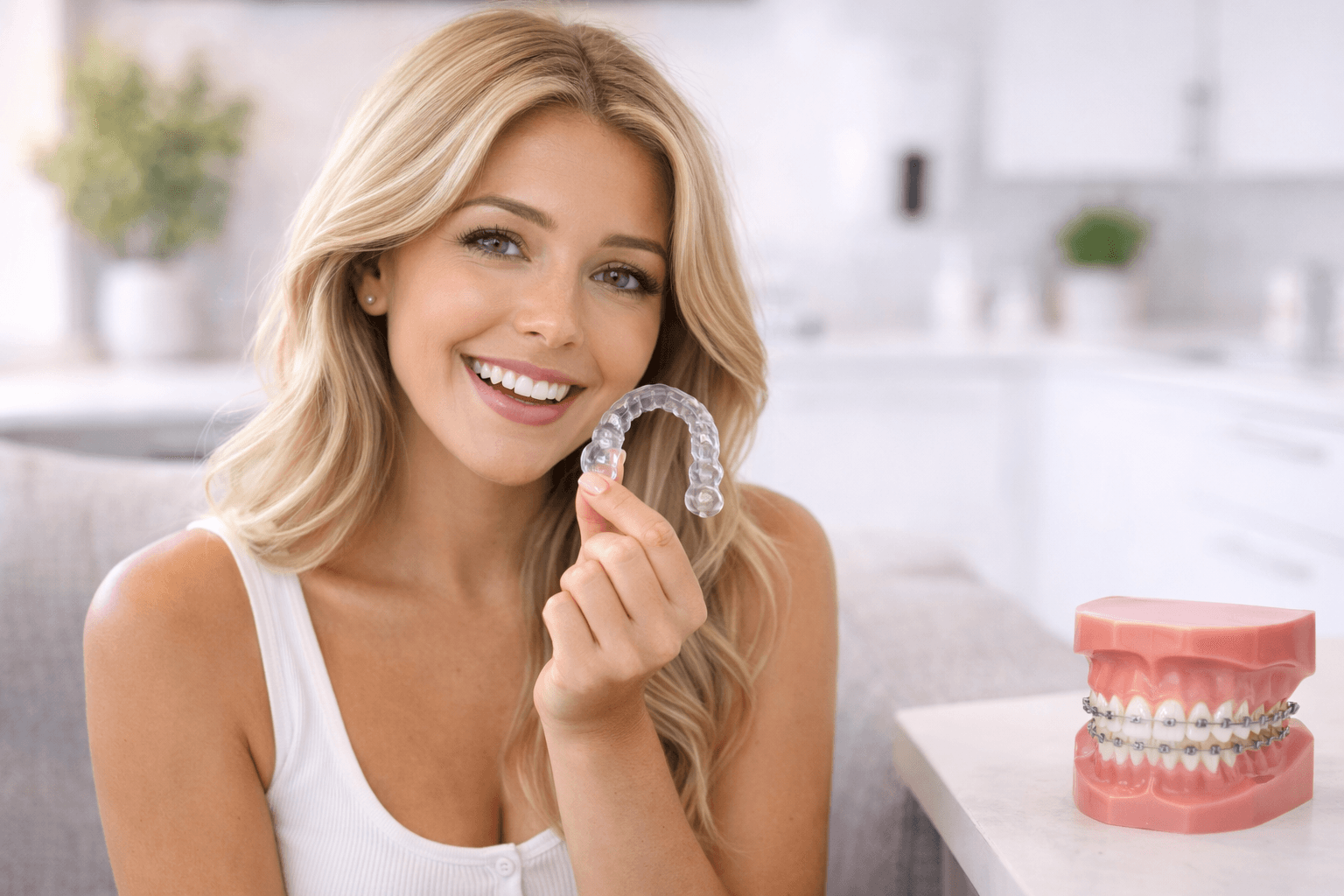
Invisalign and braces both straighten teeth effectively, but they differ in cost, comfort, appearance and what they can treat. Invisalign costs £2,500–£5,500 in the UK and uses removable clear aligners. Traditional braces cost £1,500–£3,500 for metal brackets and wires fixed to your teeth. Invisalign works best for mild to moderate cases; braces handle all complexity levels including severe crowding and bite correction. Neither is available on the NHS for adults.
This guide compares every factor that matters so you can make an informed choice. For a deeper dive into clear aligners specifically, see our complete guide to Invisalign and clear aligners.
Side-by-side comparison
| Factor | Invisalign | Traditional braces |
|---|---|---|
| UK cost | £2,500 – £5,500 | £1,500 – £3,500 (metal) |
| Treatment time | 6 – 18 months | 12 – 24 months |
| Visibility | Nearly invisible | Visible (metal or ceramic) |
| Removable | Yes — remove to eat and brush | No — fixed throughout treatment |
| Diet restrictions | None | Avoid hard, sticky, crunchy foods |
| Oral hygiene | Easy — brush and floss normally | Harder — need special brushes and floss threaders |
| Pain / comfort | Pressure feeling, no wires | Bracket irritation, wire poking |
| Best for | Mild to moderate cases | All complexity levels |
| NHS available | No (private only) | Under-18s with clinical need |
| Compliance needed | High — must wear 20–22 hrs/day | None — works automatically |
How much does Invisalign cost in the UK?
Invisalign pricing depends on the complexity of your case:
| Invisalign tier | Case type | UK cost | Treatment time |
|---|---|---|---|
| Invisalign i7 / Express | Very mild (minor touch-ups) | £1,500 – £2,500 | 3 – 6 months |
| Invisalign Lite | Mild cases (minor crowding/gaps) | £2,500 – £3,500 | 6 – 12 months |
| Invisalign Comprehensive | Moderate cases | £3,500 – £5,500 | 12 – 18 months |
| Invisalign Teen | Teenagers | £3,000 – £4,500 | 6 – 18 months |
Most Invisalign packages include all aligners, refinement aligners if needed, and retainers after treatment. Always confirm what's included — some clinics charge separately for retainers (£125–£300 per set).
Finance example: Invisalign Comprehensive at £4,000 on a 12-month 0% plan = £333 per month. Many clinics offer interest-free finance through providers like Chrysalis Finance or Tabeo.
How much do braces cost in the UK?
| Brace type | UK cost | Visibility |
|---|---|---|
| Metal braces | £1,500 – £3,000 | Most visible |
| Ceramic braces (tooth-coloured) | £2,000 – £3,500 | Less noticeable |
| Lingual braces (behind teeth) | £3,000 – £8,000 | Hidden completely |
| Self-ligating (Damon) | £2,500 – £4,000 | Similar to metal |
Metal braces remain the most affordable option and are often the clinical first choice for complex cases. Ceramic braces cost more but blend with your teeth. Lingual braces are fitted behind your teeth and are completely invisible, but they're the most expensive option and require a specialist orthodontist.
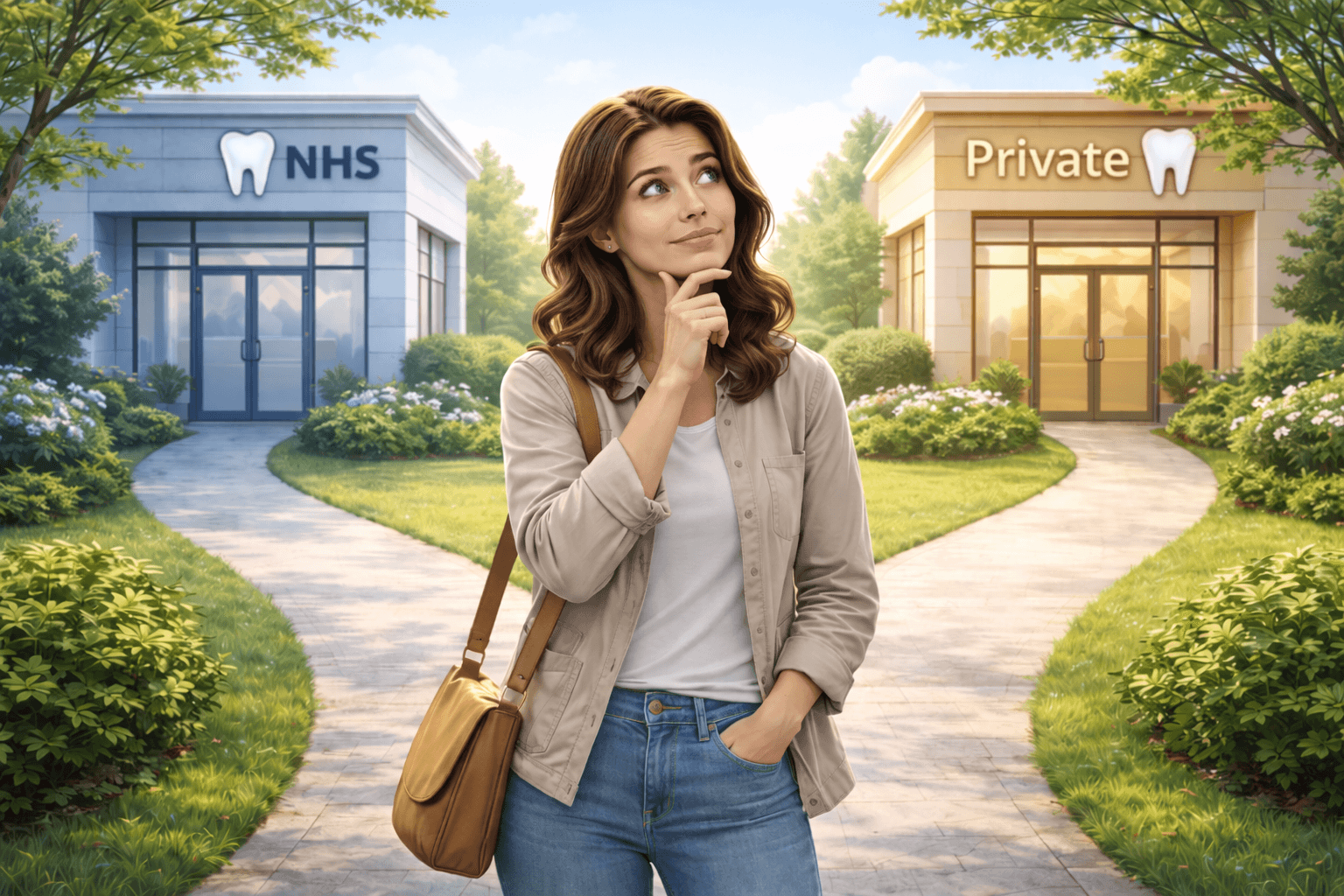
NHS orthodontic treatment
The NHS provides orthodontic treatment for children and young people under 18 if they have a clear clinical need, assessed using the Index of Orthodontic Treatment Need (IOTN). This means:
- Free for under-18s with moderate to severe orthodontic issues (IOTN grade 3.6 or above)
- Not available for adults — adult orthodontics is private in almost all cases
- Braces only — the NHS does not fund Invisalign; it provides fixed metal braces
- Waiting lists — expect 6–18 months from referral to treatment starting
If your child needs orthodontic assessment, your NHS dentist can refer them to an orthodontist. The British Orthodontic Society provides a directory of registered orthodontists.
Effectiveness: what can each treatment fix?
Cases where both work equally well
- Mild to moderate crowding
- Gaps between teeth
- Minor overbite or underbite
- Teeth that have shifted after previous orthodontic treatment
Cases where braces have an advantage
- Severe crowding requiring extractions
- Complex bite correction (deep overbite, significant crossbite)
- Large vertical tooth movements
- Teeth that need significant rotation (>40 degrees)
- Very young patients who may not comply with removable aligners
Cases where Invisalign has an advantage
- Adults who need discreet treatment for professional or social reasons
- Patients with good compliance who can commit to 20–22 hours daily wear
- Mild to moderate cases where shorter treatment time is preferred
- Patients who want to maintain normal oral hygiene during treatment
According to the British Dental Journal, Invisalign can now treat approximately 90% of orthodontic cases, though complex cases may still achieve better results with fixed braces.
Pain and comfort
Research consistently shows that clear aligners cause less discomfort in the first week of treatment compared to braces:
- Invisalign: A feeling of pressure and tightness, especially for the first 2–3 days of each new aligner. No risk of bracket irritation or wire poking
- Braces: Soreness in teeth and gums for 3–7 days after each adjustment. Brackets can irritate cheeks and lips (orthodontic wax helps). Occasional wire poking requiring emergency visits
By the second or third week, comfort levels are similar for both treatments.
Daily life with Invisalign vs braces
Eating and drinking
- Invisalign: Remove aligners before eating or drinking anything other than water. This means no dietary restrictions — eat whatever you like. The catch: you must brush before putting aligners back in
- Braces: Avoid hard foods (nuts, apples, crusty bread), sticky foods (toffee, chewing gum), and very crunchy foods. These can break brackets or bend wires, leading to emergency appointments
Oral hygiene
- Invisalign: Brush and floss normally. Clean aligners with lukewarm water and a soft brush (no hot water — it warps the plastic). The Oral Health Foundation recommends brushing after every meal before reinserting aligners
- Braces: Requires interdental brushes, floss threaders or a water flosser. Food gets trapped around brackets easily. Your dentist may recommend a fluoride mouthwash to prevent decalcification (white spots) around brackets
Appointments
- Invisalign: Check-ups every 6–8 weeks, typically 15–20 minutes. You may receive several sets of aligners at once
- Braces: Adjustments every 4–6 weeks, typically 20–30 minutes. Wire changes and tightening are done at each visit
Which is better for adults?
Most adult patients choose Invisalign for its discretion. Professional settings, social situations and dating are the most commonly cited reasons. The British Orthodontic Society reports that adult orthodontic treatment in the UK has grown significantly, with clear aligners driving much of that increase.
However, braces remain the better clinical choice for adults with:
- Complex bite issues requiring precise tooth control
- Budget constraints (metal braces are typically £1,000–£2,000 cheaper)
- Concerns about compliance (if you're not confident you'll wear aligners 22 hours daily, braces work automatically)
How to choose the right provider
When comparing clinics for either treatment:
- Check qualifications — for Invisalign, check the provider's tier (Bronze to Diamond+, indicating case volume). For braces, look for a specialist orthodontist registered on the GDC Specialist List
- Ask for before-and-after photos of cases similar to yours
- Get a detailed treatment plan — including total cost, treatment timeline, number of aligners/adjustments, and what's included
- Verify GDC registration — all dentists and orthodontists must be registered with the General Dental Council
- Read patient reviews — look specifically for orthodontic treatment reviews, not just general dental reviews
Pearlie tip: Ask your dentist if they offer both Invisalign and braces. A provider who can offer both is more likely to recommend the treatment that's clinically best for you, rather than the only one they provide.
Frequently asked questions
Is Invisalign cheaper than braces in the UK?
Not usually. Metal braces (£1,500–£3,000) are typically cheaper than Invisalign (£2,500–£5,500). However, for very mild cases, Invisalign Express or i7 (from £1,500) can be comparable to or cheaper than braces. Lingual braces (£3,000–£8,000) are more expensive than either option.
Can Invisalign fix an overbite?
Yes. Invisalign can treat mild to moderate overbites using attachments (small tooth-coloured bumps) and elastic bands. Severe overbites with skeletal components may be better treated with braces, sometimes in combination with other appliances. Your orthodontist will assess this at your consultation.
How long does Invisalign take compared to braces?
Invisalign typically takes 6–18 months for mild to moderate cases. Braces take 12–24 months for similar cases. For complex cases, braces may actually be faster because they offer more precise tooth control. Treatment time depends more on the complexity of your case than the system used.
Can adults get braces on the NHS?
In almost all cases, no. NHS orthodontic treatment is available for under-18s with a clinical need. Adult NHS orthodontics is only provided in exceptional circumstances (usually through hospital referral for severe jaw/bite problems). Adults wanting orthodontic treatment will need to go private.
Do I need to wear a retainer after treatment?
Yes, with both options. Without a retainer, teeth naturally drift back toward their original positions. Most orthodontists recommend wearing a retainer nightly for at least 12 months, then a few nights per week long-term. Options include removable clear retainers (similar to Invisalign aligners) or a fixed wire bonded behind your front teeth. The British Orthodontic Society advises lifelong retainer use for the best long-term results.
What happens if I lose an Invisalign aligner?
Contact your dentist. Depending on where you are in the treatment sequence, they may advise you to move to the next aligner, go back to the previous one, or order a replacement. Replacement aligners typically cost £50–£100 and take 1–2 weeks to arrive.
Prices in this guide are indicative and based on UK market data as of February 2026. Always confirm pricing directly with your chosen clinic. Pearlie does not provide dental advice — treatment decisions should be discussed with a GDC-registered dentist or specialist orthodontist.
Looking for a dentist?
Pearlie matches you with verified, GDC-registered clinics tailored to your needs. Free and independent.
Find my clinic